

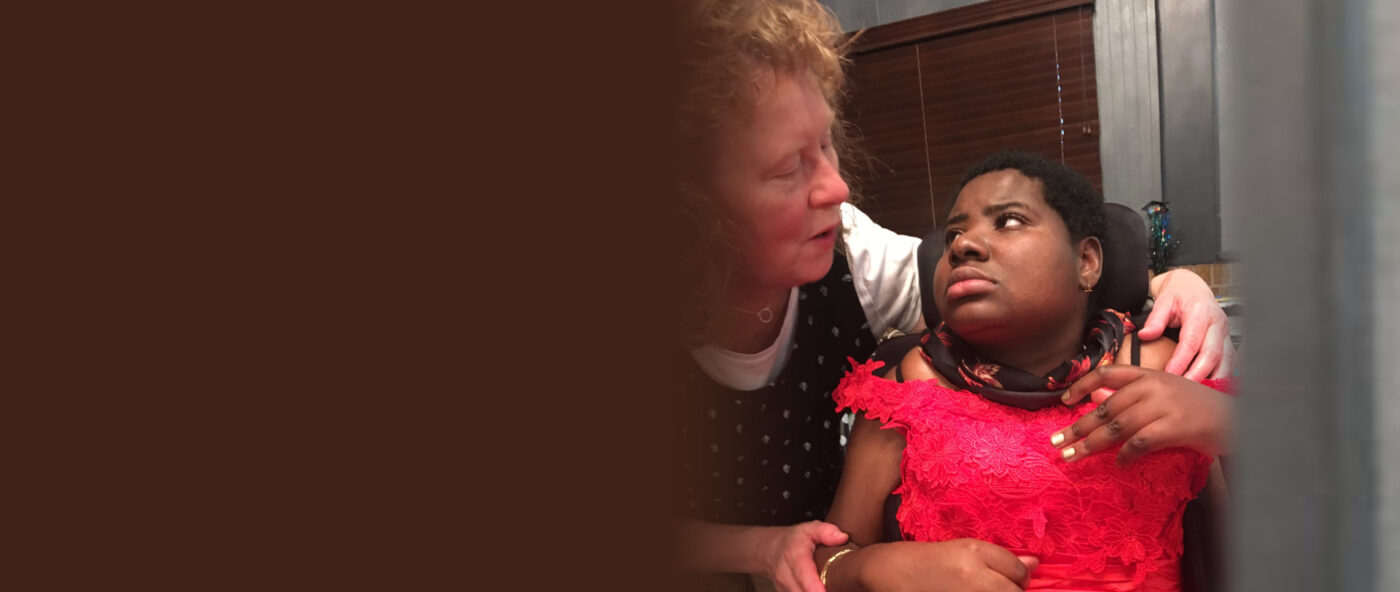
Everyone has a story and this story guides their views and influences how they navigate life. I consider myself as having Abraham’s blessings – Mother of a multitude of children. However, I am greatly inspired by one of my daughters, Ewokolo. She is an adult child who has never talked nor walked. Irrespective of her disabilities, she is the happiest and most grateful individual I have known all my life. She has taught me to appreciate the little things I have always taken for granted and more especially, taught me the true meaning of patience, love and happiness. She is the reason I am an advocate for individuals with disabilities and most especially an advocate for the underprivileged.
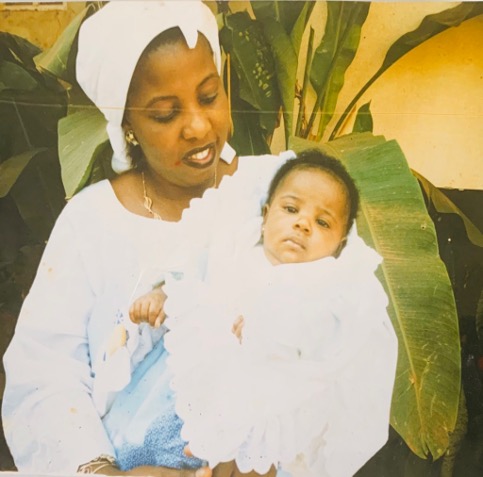
Ewokolo just turned one when my family and I migrated to the USA. She was developing beautifully in most areas but at age one she was still sitting and scooting on her butts. Her greatest milestone was holding onto the coffee table trying to stand. She never could stand on her own, never walked nor talked. As a mom, I struggled with the guilt, shame, and frustrations any mother in my situation would, but was comforted by the hope that modern medicine and my faith in God would alleviate the situation. It did though but not in the way that I envisioned.
When she started preschool, I decided to go back to school for a second Masters’ degree in education, this time, in special education because I wanted to understand more what special education entails and what it means having a child with gross developmental issues. I must say school was very therapeutic and helped moderate the guilt and eliminate the shame. Working as a special education teacher in K -12 settings and as a caregiver in a community based residential facility also exposed me to many opportunities to understand the true meaning of human dignity and what true happiness means. The world would be a happier place if everyone, irrespective of abilities and needs is connected with the right opportunities to maximize their promises.
I remembered in April1997, at the banks of the River Jordan in Israel, I muttered to myself as I stealthily rubbed the not-so-clear waters of the river on my tummy: “Lord, this child is going to be an exceptional baby.” This manifestation was a consequence of me having this divine experience, standing by the Jordan, where the Savior was baptized, with her. Years after she was born, I have not stopped thinking about this moment and even blaming myself for going abroad to study the teaching of science in Early Childhood at the Golda Meir Center in Haifa, Israel. Yes, my daughter turned out to be exceptional in many ways. She is very gifted, obedient and very accepting. She is actually the happiest person I have ever met. That is why my whole life revolves around her. She has taught me the true meaning of love, compassion, patience, and forgiveness. I thank God Almighty for her every day. Many times though, I wish she could make her needs known and could go where she wants and whenever instead of having parents and family make those decisions for her. Through her enlightenment I now see the world as one big stage where individuals as the main actors, each have a unique role to play. No doubt, her role in my life is measureless. I consequently believe that the choices we make with the opportunities presented to us influence how we shape and reshape the world. Ewokolo helped me develop my passion for dignifying differences and celebrating the kaleidoscope of the human race.
Growing up, I was not opportune to interact and understand variety, uniqueness, out-of-the-ordinary and extraordinary individuals. Looking back, I assume it was not because these individuals were not there, but more, because they were separated from the rest of community and misjudged. Further, there were little or no opportunities for those who didn’t fit the human mold to shine. In other words, the education system in which I grew up tracked learners and sifted individuals at every stage of the schooling ladder, elementary, secondary, high school and university. Only the very gifted and rich ones were blessed with a good secondary/high school education. A child born with a disability was looked at with scorn and blamed for not wanting the mother to progress. Schooling was not even an option. Indeed, children with development disabilities were considered to be responsible for their fate. As I grew older, I started sympathizing with these children.
My poor understanding of biology and the developmental stages of the fetus gave me the false idea that the mothers were probably wearing tight clothes and belts while pregnant and possibly responsible for the deformities of their babies. How I loathed the mothers for doing that to their children! Then came 1997. I just realized that I was pregnant after I was
awarded a full scholarship to study in Haifa, Israel. The course was a rigid one, and the award letter stated that participants would be disqualified if discovered pregnant. One of my confidants advised that I do not throw away the opportunity with the argument that
“…no one there would know how you normally look. Go, Auntie (that’s what she called me), you are always very healthy during your pregnancies and by the time you will really show, the semester must have ended … If at all you show while you are there, the worse-case scenario, as stated on the award letter, is that your stay would abruptly end and you will be sent back home … The bottom line, you lose nothing because you could still say you have been to Israel, the ‘Promised Land’. Do not throw the opportunity away, or else you will always see this child as the one who caused it.”
That was the smartest idea and one that my significant half also embraced in a land where opportunities were rare and hard to come by.
While at Haifa, my outlook at exceptionalities evolved from sympathy for “victims” and anger against mothers to that of empathy for both the mother and the student. Maybe, in a way, the Almighty Power was preparing me for the task ahead. I visited a self-contained autistic school. The teachers were celebrating a twelve-year-old for uttering her first word. I saw this little six-year old. She was non-verbal and her gait was a little unsteady. Tears were streaming down my cheek as I thought, “How could this mother smile, get good sleep, or even eat? Why should the Almighty let this happen? At least, she could have some words if she was struggling to walk or be able to walk if she had no words.”
Today, I am one of those mothers. Surprisingly, I smile, get good sleep, and eat. Having my daughter with the baggage was a mixed blessing to me. As a mother, I weep to see her stuck to a wheelchair, not able to think aloud for herself and make her needs known. At the same time, her condition helped me to grow as a person and a professional. I empathize with individuals with exceptionalities because of the firsthand opportunities she happened to have provided for me. I also appreciate all the issues that are taken for granted about giftedness and the need for inclusion. I now understand that because humans possess an essential nature of good and evil, all individuals can be ‘good people’ and are also capable of exhibiting inappropriate behavior. I also understand that all humans are just a few minutes away from being disabled or incapacitated. Therefore, while we are able, we should show love and understanding and advocate for those of us who are less privileged because we may be just building better services for ourselves or loved ones.